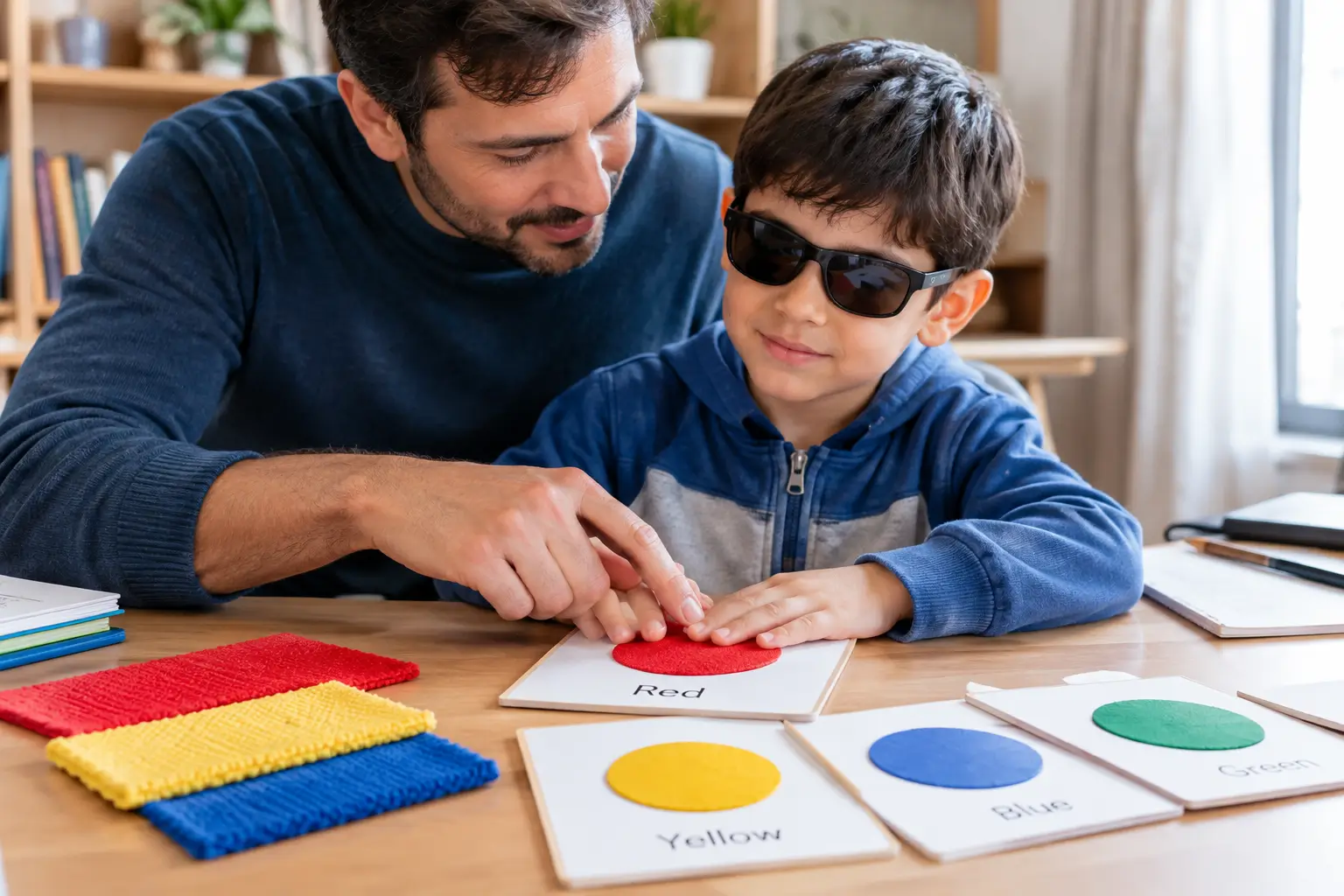
If your son is blind or has very limited vision, you do not need to find a way to make him “see” red, blue, green, or yellow through another sense. Instead, help him understand colour as a property of objects, a useful word, and a way people describe and organize the world.
You can talk about colours naturally in everyday life, connect colour names with familiar objects, explain common cultural associations, and create tactile activities that make colour vocabulary meaningful. If your son has never had useful vision, it is also important to be honest: a visual experience of colour cannot be perfectly translated into touch, sound, temperature, smell, or taste.
The goal is not to create a fake replacement for sight. The goal is to help your child build a useful, accurate concept of colour in a way that makes sense to him.
Can a Blind Child Understand Colours?
Yes. A child who is blind can learn colour names, understand that objects have colours, remember which colour belongs to a particular object, and understand that people use colours to communicate information.
For example, a child may learn that:
- Grass is commonly described as green.
- Bananas are commonly yellow.
- Fire trucks are often red.
- Pumpkins are commonly orange.
- Snow is often described as white.
- The night sky is often described as dark or black.
This does not mean the child experiences colour visually in the same way as a sighted person. It means the child can develop meaningful knowledge about colour and how colour is used in language and everyday life.
The National Braille Press gives a particularly useful perspective: a person who has never seen colour can still know the colours of many familiar things and understand that colour carries cultural and symbolic information.
That distinction is one of the most important things for parents to understand.
First, Separate “Knowing a Colour” From “Seeing a Colour”
Imagine your son asks:
“What does red look like?”
There are actually two different questions hidden inside that sentence.
The first is:
“What does the word red mean?”
The second is:
“What is the visual experience of seeing red?”
You can teach the first very well. The second is much harder to communicate to someone who has never had visual experience.
This is why saying something like “red feels hot” can be useful as an association, but it should not be presented as the definition of red.
Red is not literally hot.
Blue is not literally cold.
Green is not literally soft.
Yellow is not literally happy.
These are associations people sometimes make with colours. They can provide your child with additional language, but they are not substitutes for visual perception.
A good explanation is therefore:
“Red is a colour. Many things have red as part of their appearance. A ripe strawberry can be red, and a fire truck can be red. Some people also associate red with heat, excitement, or strong feelings, but those are associations rather than what red actually looks like.”
That approach gives your child information without giving him a misleading definition.
Has Your Son Ever Seen Colours Before?
Before deciding how to explain colour, think about his visual history.
There is a significant difference between:
- A child who has been blind since birth,
- A child who had useful vision and later lost it,
- A child with low vision,
- A child with cerebral/cortical visual impairment (CVI), and
- A child whose vision changes depending on lighting, contrast, distance, or other conditions.
If your son saw colours clearly when he was younger, he may have visual memories that you can use in your conversations.
You might ask:
“Do you remember what the sky looked like?”
or:
“Do you remember the colour of your favourite shirt?”
For a child who has never experienced useful colour vision, the conversation needs to be different. You can teach colour vocabulary and meaning without assuming that he has a visual memory to connect it to.
Children with CVI can also experience vision very differently from one another. Perkins notes that some children with CVI may use colour, contrast, context, sound, and tactile exploration as supports for visual attention and recognition.
So avoid assuming that every child described as “blind” learns in the same way.
Start Talking About Colour Naturally
One of the simplest things you can do is stop treating colour as a forbidden subject.
You do not need to avoid phrases such as:
- “That is a blue cup.”
- “Your red shirt is on the chair.”
- “Let’s find the yellow banana.”
- “The flowers are purple.”
- “Would you like the green or orange toy?”
The National Braille Press specifically recommends talking about colours naturally in everyday conversation rather than avoiding the subject.
This matters because colour is part of ordinary language.
Sighted children hear colour words constantly. A blind child can also hear them constantly and learn what those words communicate.
You do not need to turn every colour encounter into a formal lesson.
If you are eating an apple, simply say:
“This apple is red.”
If you are getting dressed:
“Your blue shirt is here.”
If you are outside:
“There are lots of green leaves on this tree.”
Over time, colour becomes part of your son’s vocabulary instead of something mysterious that adults are afraid to discuss.
Explain Colours Through Familiar Objects
Concrete objects are usually more useful than abstract explanations.
Instead of spending ten minutes explaining what yellow is, give your child something meaningful to connect with.
For example:
Yellow: banana, lemon, sunflower, school bus
Green: leaf, grass, cucumber, frog
Red: apple, strawberry, fire truck, stop sign
Blue: sky, jeans, ocean, many everyday objects
Orange: pumpkin, orange fruit, traffic cone
Purple: grapes, lavender, some flowers
Brown: tree bark, chocolate, leather shoes
Black: some cats, tires, hair, certain clothing
White: milk, paper, clouds, snow
These examples are not definitions. They are references.
A child can learn:
“When people say ‘red,’ that is the colour associated with the strawberry.”
That gives the colour word a place in his knowledge of the world.
Use Real Objects Before Abstract Descriptions
Hands-on experiences can be particularly useful for children with significant visual impairments.
Paths to Literacy recommends giving children concrete experiences with real objects before expecting them to understand tactile representations or abstract pictures.
For example, if you want to introduce “green,” you could explore a real leaf together.
Let your son:
- Touch the leaf,
- Feel its shape,
- Notice its veins,
- Smell it if appropriate,
- Hear the sound it makes,
- Learn the word “leaf,”
- and then learn that people commonly describe this type of leaf as green.
Now he has several pieces of information connected together:
Leaf → shape → texture → smell → real-world experience → word → colour
The leaf’s texture is not what green looks like. It simply gives your child a concrete experience that can be connected with the colour word.
How Can I Explain Red to a Blind Child?
Try something simple and accurate:
“Red is a colour. Strawberries, apples, roses, and many fire trucks can be red. People sometimes associate red with heat, excitement, danger, or strong emotions. Those are common associations, not the definition of red.”
You could then let your child explore a strawberry, smell it, taste it, and feel its shape.
The important point is that the sensory experience supports the concept and vocabulary. It does not recreate the visual appearance of red.
How Can I Explain Blue?
You could say:
“Blue is a colour. People often describe the sky and some water as blue. Blue is also a common colour for clothes, toys, cars, and many other objects.”
If your child has experienced the ocean, swimming pool, rain, or sky before, you can use those memories.
You might also explain that people sometimes associate blue with calmness or coolness.
Again, make the distinction clear:
“Some people associate blue with cool or calm feelings. That is what people sometimes connect with blue; it isn’t what blue physically feels like.”
How Can I Explain Green?
Green is especially easy to connect with familiar objects.
You might say:
“Green is a colour that you often hear associated with leaves, grass, trees, vegetables, and many plants.”
If you are outdoors, use the environment around you.
Touch a leaf.
Walk across grass.
Smell a plant.
Then say:
“People describe this grass as green.”
For children with some usable vision, colour can also be deliberately linked to familiar objects and concepts. Perkins recommends conceptual links such as “grass green” when teaching children with visual impairments, particularly when colour remains part of their usable visual information.
What About Yellow, Orange, Purple, Brown, Black and White?
You can use the same approach.
Yellow
“Yellow is the colour people commonly associate with bananas, lemons, sunflowers, and some flowers.”
You can also explain that yellow is often used on warning signs because it is visually noticeable.
Orange
“Orange is the colour of many pumpkins, oranges, and traffic cones.”
The fruit gives your child several sensory experiences while the colour becomes another piece of information.
Purple
“Purple is a colour associated with things such as grapes, lavender, and some flowers.”
Brown
“Brown is commonly associated with things like tree bark, soil, chocolate, and some wooden objects.”
Black
“Black is a colour often associated with things such as tires, some clothing, certain animals, and dark hair.”
White
“White is a colour commonly associated with paper, milk, clouds, and snow.”
Remember: the examples can vary. Not every banana is equally yellow, not every tree is brown, and not every cloud is white.
That is actually a useful lesson.
Teach That Objects Can Have Different Colours
Once your child understands basic colour vocabulary, introduce variation.
A simple example is an apple.
You can say:
“Apples can be red, green, or yellow.”
Then explain:
“So the word ‘apple’ tells us what the object is, while its colour gives us another piece of information about what it looks like.”
This helps prevent a common misunderstanding: believing that every object has one permanent colour.
The National Braille Press recommends introducing these subtleties gradually—for example, explaining that apples can be green or red and that the sky can appear different depending on weather.
Create a Tactile Colour Book
A homemade tactile colour book can turn colour vocabulary into a hands-on learning activity.
Paths to Literacy describes tactile colour-word books in which each colour is represented with a tactile illustration and the corresponding colour word in Braille. Examples include using a fire truck for red, leaves for green, pumpkins for orange, and a sunflower for yellow.
You can create a simple version at home.
For each page, include:
Colour name: RED
Real-world object: strawberry
Tactile item: textured strawberry shape or safe object
Braille: the colour word, if appropriate for your child’s literacy instruction
Conversation: “Strawberries are often red.”
Another page might say:
Colour name: GREEN
Object: leaf
Tactile item: real or artificial leaf
Conversation: “People commonly describe leaves as green.”
Let your son help create the book.
That turns him from a passive learner into an active participant.
Let Your Son Create His Own Colour Associations
This is one of the most valuable ways to make colour meaningful.
Ask:
“What does red make you think about?”
Maybe he says:
- Strawberries,
- A favourite toy,
- A particular sound,
- A family memory,
- A food,
- A story,
- or something completely unexpected.
There is no need to correct a personal association just because it differs from yours.
A person who has never seen colour may develop a rich personal vocabulary around colour without experiencing the visual sensation itself.
The National Braille Press also discusses connecting colours with feelings and other sensory ideas. These can be useful as personal associations, provided they are not presented as universal definitions.
Use Colour in Everyday Routines
Colour can become practically useful, not just educational.
For example, colour can help with:
- Choosing clothes,
- Organizing toys,
- Identifying school supplies,
- Sorting objects,
- Talking about pictures,
- Discussing art,
- Understanding flags,
- Following sports,
- Describing people,
- Talking about traffic signals,
- Identifying packaging,
- Understanding books and stories.
For a child with usable vision, colour may also have direct functional value. Perkins describes activities that use real coloured objects to practice colour matching and identification, gradually introducing more colours and shades.
For a child with no useful vision, the colour information may be primarily linguistic and descriptive rather than visual.
Both forms of learning can be meaningful.
Teach Colour Symbolism Carefully
Colours have cultural meanings, but those meanings are not universal.
For example:
- Red can be associated with love, anger, danger, celebration, or energy.
- Blue can be associated with calmness, sadness, trust, or coolness.
- Green can be associated with nature, growth, money, or permission.
- White can represent cleanliness, peace, celebration, or mourning depending on the culture.
- Black can represent elegance, darkness, mourning, formality, or many other ideas.
Instead of saying:
“Red means anger.”
say:
“In some situations, people use red to represent anger, danger, love, excitement, or strong feelings.”
This teaches your child that colour symbolism depends on culture, context, and situation.
What If My Son Asks, “What Does Red Look Like?”
This may be the hardest question.
You do not have to invent an answer.
You can say:
“Red is something sighted people experience visually. I can tell you what things are often red and what people sometimes associate with red, but I can’t turn the visual experience of red into a feeling you can touch or hear.”
That answer is honest.
You could continue:
“A strawberry can be red. A stop sign can be red. Some roses are red. People sometimes connect red with heat or strong feelings. But none of those things is exactly what red looks like.”
There is nothing wrong with telling your child that some experiences are difficult to translate between senses.
In fact, honesty can be more helpful than forcing an artificial comparison.
What Not to Say When Explaining Colours
Avoid statements that turn associations into supposed definitions.
Avoid:
“Red feels hot.”
Better:
“People sometimes associate red with heat.”
Avoid:
“Blue feels cold.”
Better:
“People sometimes connect blue with coolness or calmness.”
Avoid:
“Green feels like grass.”
Better:
“Grass is often described as green. You can feel the grass while learning the colour word associated with it.”
Avoid:
“Yellow is happiness.”
Better:
“Yellow is sometimes associated with happiness or cheerfulness in certain contexts.”
Avoid:
“Black means sadness.”
Better:
“Black can have different meanings depending on the situation and culture.”
This distinction protects your child from learning inaccurate rules about colour.
Don’t Assume Touch Can Replace Sight
It is tempting to say:
- red is hot,
- blue is cold,
- green is soft,
- yellow is bright,
- purple is sweet.
These descriptions may sound poetic, but they can create confusion if presented as literal explanations.
A colour does not have a particular temperature or texture.
- A red object can be cold.
- A blue object can be warm.
- A green object can be rough.
- A yellow object can be smooth.
The sensory property belongs to the object, not to the colour itself.
This is one of the biggest improvements you can make over simplistic “how to explain colours to a blind child” advice.
Turn Colour Learning Into a Game
Learning does not need to feel like a lesson.
Try a Colour Hunt.
Choose one colour and look for objects associated with it.
For example:
“Today we’re learning about red. Can you find something that I told you is red?”
You can then discuss each object.
Another activity is Colour Sorting.
Put several familiar objects into a container and give your son colour information about them. He can sort them according to the colour names he has learned.
You can also play Colour Questions:
“What colour is a banana usually?”
“What colour can an apple be?”
“What colour do people commonly call grass?”
“Can a shirt be blue?”
“Can an apple be green?”
Paths to Literacy has examples of tactile books, tactile patterns, real objects, and multisensory activities that can be adapted for children with visual impairments.
Give Him Real Experiences, Not Just Descriptions
This principle goes beyond colour.
A child who is blind benefits from opportunities to explore real objects and experiences rather than receiving only verbal explanations. Paths to Literacy emphasizes hands-on experiences as an important foundation for children with visual impairments, while tactile representations become more meaningful when the child already understands the real object or experience behind them.
So when you teach “green,” don’t only say:
“Green is the colour of plants.”
Go outside.
Touch the leaves.
Feel the grass.
Smell the plants.
Listen to the environment.
Talk about what the plant is.
Then add:
“People describe this as green.”
That creates a much richer concept.
If Your Child Has Some Useful Vision
If your son has low vision rather than complete blindness, do not assume that nonvisual teaching is always the best approach.
Some children with visual impairments can use colour and contrast effectively.
For example, educational materials may benefit from:
- strong colour contrast,
- uncluttered backgrounds,
- larger targets,
- consistent colour coding,
- reduced glare,
- carefully selected lighting,
- and colours that the child responds to most reliably.
Perkins notes that the appropriate use of colour can vary considerably among children with visual impairments, particularly those with CVI, so materials should be individualized rather than based on one universal colour rule.
If your son has usable vision, his teacher of students with visual impairments or other educational professionals can help determine which visual supports work best for him.
A Simple Way to Explain Colour to Your Son
If you want one short explanation that you can actually use, try this:
“Colours are words people use to describe how things look. Red, blue, green, yellow, and other colours are different visual qualities that objects can have. I can tell you which colours things are and what people sometimes associate with those colours. You can learn what the colour words mean and how people use them, even if you don’t experience the visual part of colour the same way I do.”
Then give him examples from his own life.
That is enough.
You do not need a perfect philosophical explanation.
You need language, experience, patience, and opportunities to ask questions.
A 10-Minute Colour Activity You Can Do Today
Try this simple activity with one colour.
Step 1: Choose one colour
Start with red, blue, green, or yellow.
Step 2: Choose three familiar objects
For example, choose a red apple, a red toy, and a red piece of clothing.
Step 3: Name the colour
Say:
“These are all red.”
Step 4: Explore the objects
Let your child touch, smell, hold, or use the objects appropriately.
Step 5: Explain the connection
Say:
“They are different objects, but people describe their colour as red.”
Step 6: Add one association
You might say:
“People sometimes associate red with excitement or danger.”
Step 7: Let your child respond
Ask:
“What does red make you think about?”
His answer can become part of his own colour vocabulary.
The Most Important Thing to Remember
You do not have to make colour “feel” like something else.
That is the central idea.
Your son can learn that colour is visual information, that objects have colours, that people use colour words every day, and that colours can carry practical, emotional, artistic, and cultural meanings.
For a child who has never experienced vision, there may always be a difference between knowing what the word red means and experiencing what red visually looks like.
That difference is okay.
Your job is not to erase it.
Your job is to give your child enough real experiences, language, context, and freedom to build his own understanding.
And the best place to begin is surprisingly simple:
Talk about colours with him. Don’t avoid them.
Frequently Asked Questions
Can a blind child understand the concept of colour?
Yes. A blind child can learn colour names, understand which colours are associated with familiar objects, recognize how colour is used in language and culture, and use colour information appropriately. This is different from having the same visual experience of colour as someone who can see.
How do you explain red to someone who cannot see?
Explain red as a colour and connect the word with familiar objects such as strawberries, apples, roses, or fire trucks. You can also discuss common associations such as heat, excitement, or danger, while making clear that these are associations rather than the visual definition of red.
Should I use temperature to explain colours?
You can use temperature as an analogy, but do not present it as a definition. For example, “people sometimes associate red with heat” is more accurate than “red feels hot.”
How can I teach colours to a blind child at home?
Use everyday objects, colour words, tactile activities, simple games, sorting activities, stories, and conversations. A tactile colour book can also combine objects, textures, colour names, and Braille where appropriate. Paths to Literacy provides examples of tactile colour books and related activities.
What if my child was born blind?
If your child has never had useful vision, avoid pretending that a sound, texture, smell, or temperature is literally what a colour looks like. Instead, teach colour as vocabulary, object information, cultural language, and a visual property that sighted people experience.
What if my child used to be able to see?
Ask about memories of colours and use those memories when appropriate. A child who previously had useful vision may have visual memories that can make colour discussions very different from those with a child who has never had visual experience.
Can children with low vision learn colours visually?
Yes, many children with low vision can use colour information, although the amount and type of useful colour vision varies. Colour, contrast, lighting, and presentation may need to be individualized. Perkins recommends adapting colour and contrast based on the particular child’s visual needs rather than using one approach for everyone.
Is it wrong to talk about colours with a blind child?
No. Avoiding colour altogether can actually remove useful vocabulary and information from everyday conversations. The National Braille Press recommends talking about colour naturally and allowing blind children to learn what colours mean in the world around them.
Helpful Resources for Parents and Educators
For more practical ideas, look for resources from organizations that work directly with children who are blind or visually impaired.
- National Braille Press — Great Expectations: practical guidance on talking about colours with blind children.
- Paths to Literacy: tactile colour books, tactile activities, and hands-on learning ideas for children with visual impairments.
- Perkins School for the Blind: resources covering concept development, colour, contrast, CVI, tactile learning, and accessible instruction.
Final Thought
If your son asks about colours, you don’t need to have a perfect answer.
You can simply tell him the truth:
“I can teach you what people mean when they talk about colours. I can tell you what things are usually called red, blue, green, or yellow. And we can discover what those colour words mean together.”
That conversation can be the beginning of a much bigger understanding of the world.