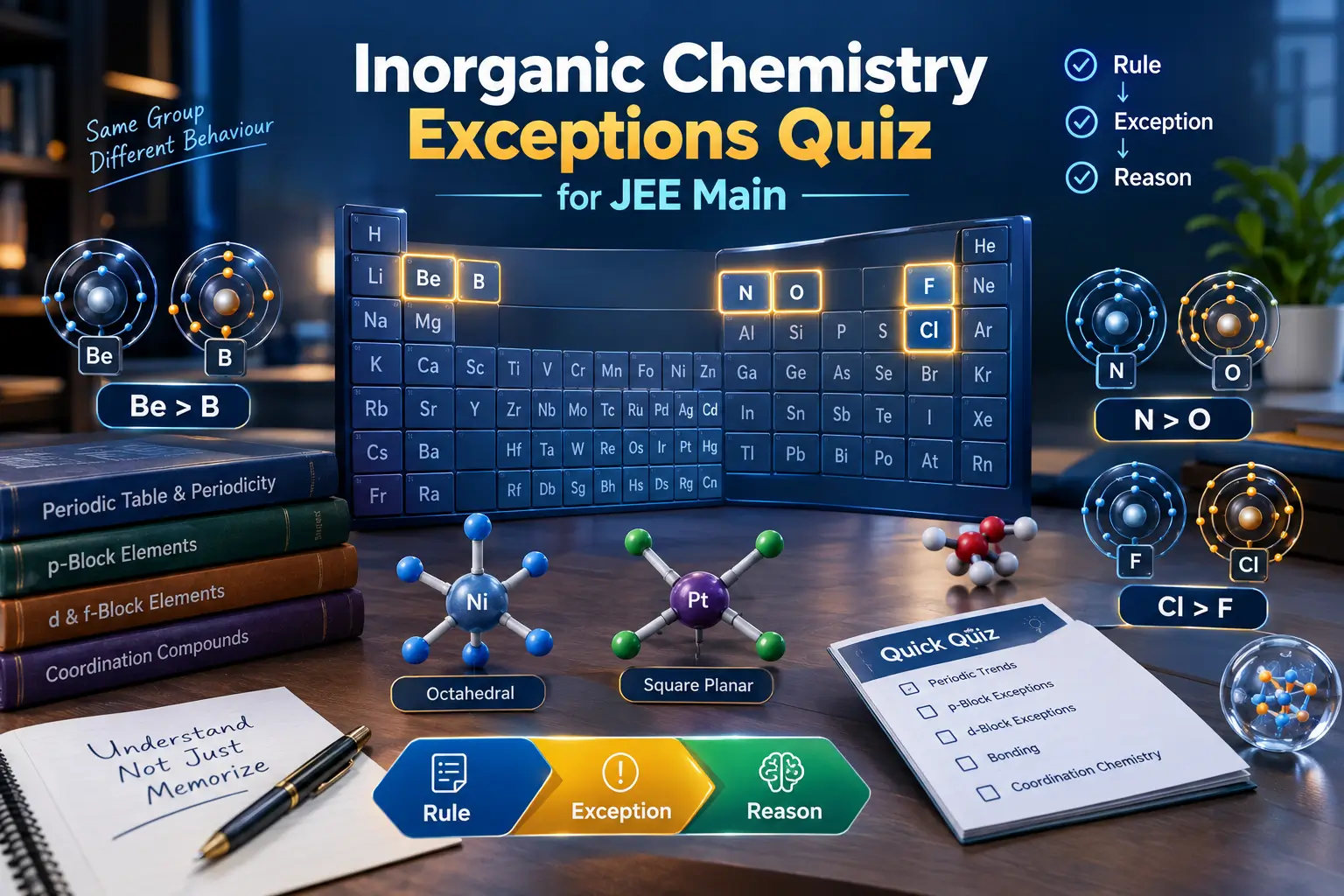
Inorganic chemistry becomes much easier when you stop treating every unusual result as a separate fact to memorize. Many JEE Main questions are built around a familiar chemical trend and then introduce an element or compound that does not follow that simple pattern. That is exactly where inorganic chemistry exceptions become important.
This quiz focuses on those high-value exceptions: irregular ionization enthalpy trends, unusual electron gain enthalpy, anomalous first-element behavior in the p-block, unusual electronic configurations of transition elements, oxidation-state patterns, and coordination-compound behavior. The goal is not simply to remember that an exception exists, but to understand what the normal rule predicts, why the exception occurs, and how JEE Main can test it.
The questions below are designed for active revision. Try to answer each one before checking the explanation.
What Are Inorganic Chemistry Exceptions?
An inorganic chemistry exception is a case where an element, ion, molecule, or compound does not follow the simple trend you would normally expect from a periodic or chemical rule.
For example, ionization enthalpy generally increases across a period. However, beryllium has a higher first ionization enthalpy than boron, and nitrogen has a higher first ionization enthalpy than oxygen. These are not random exceptions. They can be explained using subshell energy, electron configuration, and electron-electron repulsion.
Similarly, electron gain enthalpy generally becomes more negative across a period, but chlorine has a more negative electron gain enthalpy than fluorine. The unusually small size of fluorine causes greater electron-electron repulsion when the incoming electron enters its compact 2p shell.
The important lesson is simple:
An exception usually has a chemical reason.
That is the mindset you need for JEE Main inorganic chemistry.
Why Should You Practice Inorganic Chemistry Exceptions for JEE Main?
The official JEE Main 2026 Chemistry syllabus includes classification and periodicity, p-block elements, d- and f-block elements, and coordination compounds. The syllabus specifically mentions periodic trends and the unusual behavior of the first element in each p-block group.
That makes exceptions especially useful for revision because they sit at the intersection of several syllabus concepts.
A question about the ionization enthalpy of nitrogen and oxygen may test periodic trends and electronic configuration at the same time. A question about boron may combine group trends, electron deficiency, covalent bonding, and anomalous first-element behavior.
NCERT’s Chemistry Exemplar also includes reasoning-based questions involving several classic exceptions, including why chlorine has a more negative electron gain enthalpy than fluorine, why gallium has a higher ionization enthalpy than aluminium, and why certain oxidation states become more stable down a group.
So the best revision strategy is not:
“Memorize 100 exceptions.”
It is:
“Understand the rule, identify where it fails, and remember the reason.”
Inorganic Chemistry Exceptions Quiz for JEE Main
How to use this quiz
For each question:
- Read the question without looking at the answer.
- Choose your answer.
- Explain the reason to yourself.
- Check the explanation.
- Write down the exception if you missed it.
A correct answer without understanding the reason is only partial revision.
Question 1: Ionization Enthalpy Exception
Which statement about first ionization enthalpy is correct?
A. Ionization enthalpy of B is greater than Be
B. Ionization enthalpy of Be is greater than B
C. Ionization enthalpy of Be and B is exactly equal
D. Ionization enthalpy always increases from Be to B
Answer: B. Ionization enthalpy of Be is greater than B
Why?
The expected periodic trend suggests that ionization enthalpy should increase from Be to B because boron comes after beryllium in the same period.
But their electron configurations are different:
- Be: 1s² 2s²
- B: 1s² 2s² 2p¹
The electron removed from boron comes from the higher-energy 2p subshell, whereas the electron removed from beryllium comes from the more stable 2s subshell.
Therefore, removing the first electron from B is easier than removing it from Be.
Exception to remember
Be > B in first ionization enthalpy.
The key is not “boron is smaller” or “the trend is wrong.” The key is the subshell from which the electron is removed.
Question 2: Nitrogen and Oxygen
Why is the first ionization enthalpy of nitrogen greater than that of oxygen?
A. Nitrogen has a larger atomic radius
B. Oxygen has a completely filled p-subshell
C. Nitrogen has a half-filled 2p³ configuration
D. Oxygen has no electron-electron repulsion
Answer: C. Nitrogen has a half-filled 2p³ configuration
Nitrogen has the configuration:
1s² 2s² 2p³
The three 2p electrons occupy the three p orbitals singly according to Hund’s rule. This half-filled arrangement has enhanced stability.
Oxygen has:
1s² 2s² 2p⁴
One of its 2p orbitals contains a pair of electrons. Repulsion within that paired orbital makes removal of one electron relatively easier.
Therefore:
N > O in first ionization enthalpy.
JEE Main takeaway
When you see an apparent periodic-trend contradiction involving Be/B or N/O, immediately check the electronic configuration.
Question 3: Fluorine vs Chlorine
Which element has the more negative electron gain enthalpy?
A. F
B. Cl
C. Both are identical
D. It depends only on atomic number
Answer: B. Cl
This is one of the classic exceptions in inorganic chemistry.
Fluorine is extremely electronegative and has a very small atomic radius. It may seem logical to assume that fluorine must therefore have the most negative electron gain enthalpy.
However, the incoming electron enters fluorine’s very compact 2p shell, where electron-electron repulsion is relatively strong.
In chlorine, the incoming electron enters the larger 3p shell, where there is more space.
As a result, adding an electron to chlorine is energetically more favorable than adding one to fluorine.
Remember
Electron gain enthalpy of Cl is more negative than that of F.
Do not confuse this with electronegativity. Fluorine remains the most electronegative element.
Question 4: The First-Element Anomaly
Which element generally shows unusual behavior compared with the other members of its p-block group because of its small size and other distinctive properties?
A. The heaviest element in every group
B. The first element of a p-block group
C. Only noble gases
D. Only transition metals
Answer: B. The first element of a p-block group
The 2026 JEE Main syllabus specifically includes the unique behavior of the first element in each p-block group.
The first member is often much smaller than the elements below it. This can produce differences in:
- bonding
- oxidation states
- catenation
- multiple bonding
- acidity/basicity
- hydride stability
- oxide structure
- electron deficiency
- coordination behavior
This is particularly important for:
B, C, N, O, and F.
Their chemistry cannot always be predicted by simply moving down the group.
Important Periodic Trend Exceptions You Should Know
Before continuing the quiz, keep these core relationships in your revision notes.
First ionization enthalpy
Across a period, ionization enthalpy generally increases, but:
Be > B
and
N > O
These arise from subshell energy and extra stability associated with particular electronic configurations.
Electron gain enthalpy
A common broad trend is that electron gain enthalpy becomes more negative across a period, but:
Cl is more negative than F.
The small size of fluorine creates stronger electron-electron repulsion in its compact 2p orbital region.
Metallic and non-metallic character
Simple periodic rules are useful, but oxidation state, bonding, atomic size, and electronic configuration can produce behavior that is more complicated than a one-direction trend.
For JEE Main, learn the reason behind an apparent contradiction rather than memorizing an isolated statement.
Question 5: The Lithium–Magnesium Relationship
Lithium shows some similarities with magnesium even though they belong to different groups. This is known as:
A. Inert pair effect
B. Diagonal relationship
C. Lanthanoid contraction
D. Back bonding
Answer: B. Diagonal relationship
Lithium is the first member of Group 1, while magnesium is the second member of Group 2.
Their diagonal similarity arises from a combination of:
- relatively small ionic size
- similar charge density
- comparable polarizing ability
- related behavior of some compounds
Examples commonly studied in chemistry include similarities involving nitrides, carbonates, and thermal decomposition behavior.
This is important because the first element of a group often behaves differently from the rest of the group.
Important caution
Do not turn the diagonal relationship into a blanket statement that every compound of Li and Mg behaves identically. It is a similarity in selected chemical properties, not an identity.
Question 6: Why Is Boron Different From Aluminium?
Which statement best explains the unusual chemistry of boron compared with the heavier members of Group 13?
A. Boron has a very large atomic radius
B. Boron has a small size and high ionization enthalpy
C. Boron is a transition metal
D. Boron has completely filled d orbitals
Answer: B. Boron has a small size and high ionization enthalpy
Boron is much smaller than aluminium and has significantly different bonding behavior.
It commonly forms covalent compounds and electron-deficient species rather than behaving like a simple metal.
For example, compounds such as BF₃ are electron-deficient at the central atom and can act as Lewis acids.
Boron also has strong covalent bonding and shows important differences from heavier Group 13 elements.
The distinction between boron and aluminium is one reason the syllabus emphasizes the unique behavior of the first element in each group.
Question 7: Transition-Metal Electronic Configuration
Which pair is famous for having an irregular ground-state electronic configuration compared with the simple Aufbau expectation?
A. Na and Mg
B. Cr and Cu
C. Ca and K
D. Al and Si
Answer: B. Cr and Cu
The commonly taught ground-state configurations are:
Cr: [Ar] 3d⁵ 4s¹
Cu: [Ar] 3d¹⁰ 4s¹
A simple filling sequence might make you expect 4s² in both cases, but the actual arrangements reflect the relative stability associated with the d subshell.
For chromium, a half-filled d⁵ arrangement is especially stable.
For copper, a completely filled d¹⁰ subshell is especially stable.
Exam habit
When a question involves transition-metal electronic configuration, do not mechanically fill orbitals and stop. Check the well-known exceptions, especially Cr and Cu.
Question 8: Which Nickel Complex Is Magnetic?
Consider:
[Ni(CN)₄]²⁻
Which statement is correct under the standard JEE-level treatment?
A. It is tetrahedral and strongly paramagnetic
B. It is square planar and diamagnetic
C. It is always octahedral
D. It contains no d electrons
Answer: B. It is square planar and diamagnetic
Ni²⁺ has a 3d⁸ configuration.
With the strong-field ligand CN⁻, the complex can adopt a square-planar arrangement in which the d electrons are paired in the standard treatment used for JEE-level coordination chemistry.
Therefore, [Ni(CN)₄]²⁻ is diamagnetic.
By contrast, [NiCl₄]²⁻ is tetrahedral and paramagnetic because chloride is a weaker-field ligand and the tetrahedral splitting pattern favors unpaired electrons.
This is a valuable example of why simply memorizing the metal ion’s d-electron count is not enough. You must also consider the ligand and geometry.
Question 9: Oxidation State Exception
Which statement about fluorine is correct?
A. Fluorine commonly shows positive oxidation states
B. Fluorine commonly shows +7 oxidation state
C. Fluorine shows −1 oxidation state in its compounds with less electronegative elements
D. Fluorine behaves like chlorine in every oxidation-state situation
Answer: C
Fluorine is the most electronegative element and normally shows an oxidation state of −1 in its compounds.
Unlike heavier halogens such as chlorine, bromine, and iodine, fluorine does not normally display the wide range of positive oxidation states associated with those elements in oxo-compounds.
This makes fluorine another important example of why group trends must not be applied mechanically.
Remember
“Same group” does not mean “same oxidation-state behavior.”
The first element can be chemically very different from the elements below it.
Question 10: Coordination Chemistry Exception
Which factor can change the magnetic behavior of a transition-metal coordination compound?
A. Only the atomic number of the metal
B. Only the color of the complex
C. Ligand strength and the resulting electron arrangement
D. Only the molecular mass
Answer: C. Ligand strength and the resulting electron arrangement
Coordination chemistry is full of cases where the surrounding ligands influence the arrangement of d electrons.
Strong-field ligands can produce greater splitting and, in suitable cases, electron pairing. Weak-field ligands produce smaller splitting and may leave more unpaired electrons.
That affects whether a complex is:
- diamagnetic
- paramagnetic
- high spin
- low spin
The JEE Main syllabus explicitly includes valence bond treatment, basic crystal field theory, colour, and magnetic properties of coordination compounds.
High-Yield Inorganic Chemistry Exceptions for JEE Main
The following table is useful as a last-minute revision sheet.
| Topic | Normal expectation | Important exception | Main reason |
|---|---|---|---|
| Ionization enthalpy | Increases across a period | Be > B | 2s electron vs 2p electron |
| Ionization enthalpy | Increases across a period | N > O | Half-filled p³ vs paired electron |
| Electron gain enthalpy | Generally more negative across a period | Cl more negative than F | Very small 2p shell of F |
| p-block | Similar group behavior | First element often differs | Small size and high charge density |
| Group 13 | Metallic tendency down group | B strongly differs from Al | Small size and covalent character |
| Group 14 | Similar oxidation trends | C differs strongly from heavier members | Small size and strong bonding |
| Group 15 | Group trend | N shows strong first-element anomaly | Small size and inability to expand octet in common compounds |
| Group 16 | −2 common | O has unusual chemistry | Small size, high electronegativity and O–O bond characteristics |
| Group 17 | Similar halogen chemistry | F behaves differently | Extreme electronegativity and small size |
| Transition metals | Aufbau expectation | Cr, Cu | Extra stability of d⁵/d¹⁰ |
| Transition complexes | Metal ion alone determines behavior | Ligand affects spin and geometry | Crystal-field splitting |
| Lanthanoids | Similar chemistry | Lanthanoid contraction affects later elements | Poor shielding by 4f electrons |
Some of these ideas appear explicitly in NCERT’s chemistry materials and exemplar problems, including anomalous first-element behavior, periodic exceptions, transition-metal chemistry, and coordination chemistry.
The Most Important Inorganic Exceptions by Chapter
1. Periodic Table and Periodic Trends
Start here because these exceptions are conceptually connected to atomic structure.
Know:
- Be vs B ionization enthalpy
- N vs O ionization enthalpy
- Cl vs F electron gain enthalpy
- unusual size-related behavior
- oxidation-state trends
- first-element anomalies
- diagonal relationships where relevant to your preparation level
The trick is to associate every exception with its electronic configuration or atomic-size explanation.
2. Chemical Bonding
Do not learn bonding rules as absolute laws.
The octet rule is a useful model, but chemistry contains:
- incomplete octets
- electron-deficient compounds
- odd-electron species
- expanded-valence descriptions used in conventional textbook treatment
- resonance
- coordinate bonding
- unusual molecular structures
For JEE preparation, the important question is not just:
“Does this molecule obey the octet rule?”
Ask:
“What electronic and structural reason explains the observed arrangement?”
3. P-Block Elements
This is one of the richest areas for exception-based questions.
Pay special attention to the first member of each group.
Boron
Boron differs substantially from aluminium because of its small size, high ionization enthalpy, and strong covalent bonding tendencies.
Carbon
Carbon has an exceptional ability to form strong C–C bonds and extensive catenation.
Nitrogen
Nitrogen’s small size and strong multiple bonding capability create major differences from heavier Group 15 elements.
Oxygen
Oxygen has unusual behavior compared with sulfur and the heavier chalcogens because of its small size, high electronegativity, and distinctive bonding characteristics.
Fluorine
Fluorine is the most electronegative element and strongly departs from several trends that might otherwise be inferred from the halogen group.
The official syllabus specifically calls out the unique behavior of the first element in each p-block group, so this area deserves deliberate revision.
4. D- and F-Block Exceptions
Transition metals require a different style of revision.
Instead of memorizing isolated properties, connect:
Electronic configuration → oxidation state → d-electron count → colour → magnetism → complex formation
Important revision points include:
- Cr configuration
- Cu configuration
- variable oxidation states
- colour of transition-metal ions
- magnetic behavior
- catalytic behavior
- complex formation
- lanthanoid contraction
- common chemistry of KMnO₄
- common chemistry of K₂Cr₂O₇
These topics are explicitly part of the JEE Main 2026 d/f-block syllabus.
5. Coordination Compounds
Coordination chemistry can look like pure memorization until you connect the concepts.
For each complex, ask:
What is the oxidation state?
Then:
What is the d-electron count?
Then:
What is the ligand strength?
Then:
What geometry is expected?
Finally:
How many unpaired electrons are present?
That sequence can help you solve questions about magnetic behavior and geometry instead of memorizing each complex separately.
Important areas include:
- coordination number
- denticity
- chelation
- nomenclature
- geometrical isomerism
- optical isomerism
- linkage isomerism
- ligand strength
- crystal-field splitting
- high-spin and low-spin behavior
- colour
- magnetic properties
These are all within the stated coordination-compound coverage for JEE Main.
Why “Rule vs Exception” Is Better Than a Memorization List
A long list of 100 or 200 inorganic exceptions may look impressive, but it is not necessarily effective revision.
Suppose you memorize:
“Cl has more negative electron gain enthalpy than F.”
You may remember the statement today and forget it next week.
Instead, remember:
- Normal rule: Electron gain enthalpy generally becomes more negative across a period.
- Exception: Cl is more negative than F.
- Reason: F’s very small 2p shell produces stronger electron-electron repulsion for the incoming electron.
Now the fact is connected to a concept.
The same method works for:
Be > B
Normal trend → exception → subshell explanation.
N > O
Normal trend → exception → half-filled configuration and electron pairing.
Cr and Cu
Expected configuration → actual configuration → extra stability.
This is the type of reasoning that makes inorganic chemistry much easier to retrieve under exam pressure.
Common Mistakes Students Make With Inorganic Exceptions
Mistake 1: Memorizing the answer without the reason
This creates confusion when the question is worded differently.
Learn the cause behind the exception.
Mistake 2: Applying periodic trends blindly
Periodic trends are generalizations, not mathematical laws that work identically for every element.
Whenever a question asks for an unusual order, inspect:
- electron configuration
- orbital type
- subshell stability
- electron-electron repulsion
- atomic size
- shielding
- effective nuclear charge
Mistake 3: Mixing up electron gain enthalpy and electronegativity
The fact that fluorine is the most electronegative element does not mean it must have the most negative electron gain enthalpy.
- Fluorine: highest electronegativity.
- Chlorine: more negative electron gain enthalpy than fluorine.
These are related but different concepts.
Mistake 4: Assuming every group member behaves identically
Group trends are useful, but first elements frequently behave differently.
Think:
B vs Al
C vs Si
N vs P
O vs S
F vs Cl
This simple comparison is extremely useful for p-block revision.
Mistake 5: Ignoring the ligand in coordination chemistry
The same metal ion can behave differently in complexes containing different ligands.
Always consider the ligand, geometry, and crystal-field splitting before deciding whether a complex is paramagnetic or diamagnetic.
How to Revise Inorganic Chemistry Exceptions Before JEE Main
A practical revision cycle can be much more effective than repeatedly reading the same chapter.
First pass: Understand
Read the rule and the exception together.
Second pass: Explain
Close your notes and explain why the exception occurs.
Third pass: Test
Solve a short quiz without looking at the notes.
Fourth pass: Correct
For every wrong answer, write the reason rather than just the correct option.
For example:
- Wrong: “I forgot Cl > F.”
- Better: “I forgot that F’s compact 2p shell creates stronger repulsion for the incoming electron.”
That second note is much more useful during final revision.
A Simple 15-Minute Inorganic Exceptions Revision Method
When you have very little time, divide the session into three parts.
Minutes 1–5: Periodicity
Revise:
- Be > B
- N > O
- Cl more negative than F
- Important first-element anomalies
Minutes 6–10: p-Block and d-Block
Revise:
- first-element behavior
- B/C/N/O/F anomalies
- Cr and Cu configurations
- important oxidation-state trends
- lanthanoid contraction
Minutes 11–15: Coordination
Revise:
- ligand strength
- coordination number
- geometry
- high spin vs low spin
- magnetic behavior
- important isomers
Then solve five questions without notes.
This turns passive reading into active recall.
What Score Should You Aim for on This Quiz?
Do not treat the score as a prediction of your JEE Main performance. A short exceptions quiz measures only a narrow slice of inorganic chemistry.
Instead, use your mistakes diagnostically:
- 9–10 correct: Your basic exception recall is strong. Move toward mixed application questions.
- 7–8 correct: Your concepts are developing, but several exceptions need reinforcement.
- 5–6 correct: Revisit periodic trends and first-element anomalies before attempting a harder quiz.
Below 5: Start with NCERT-based concepts and electronic configurations, then return to the quiz.
The objective is not to obtain a perfect score on the first attempt. The objective is to make every mistake useful.
Frequently Asked Questions
What are the most important inorganic chemistry exceptions for JEE Main?
High-value areas include Be vs B ionization enthalpy, N vs O ionization enthalpy, chlorine vs fluorine electron gain enthalpy, anomalous first-element behavior in the p-block, Cr and Cu electronic configurations, important oxidation-state trends, lanthanoid contraction, and coordination-compound magnetic behavior.
These topics connect directly with the inorganic chemistry areas listed in the JEE Main syllabus.
Is inorganic chemistry mostly memorization for JEE Main?
Memorization is necessary for some facts, but understanding the reasons behind trends and exceptions makes retention much stronger.
A good strategy is to combine NCERT-based reading with active recall and exception-focused questions.
Why is chlorine’s electron gain enthalpy more negative than fluorine’s?
Fluorine has a very small 2p shell. The incoming electron experiences relatively strong electron-electron repulsion in this compact region. Chlorine’s larger 3p shell provides more space, making electron addition energetically more favorable. NCERT’s Chemistry Exemplar specifically includes this relationship as a reasoning question.
Why is nitrogen’s ionization enthalpy higher than oxygen’s?
Nitrogen has a relatively stable half-filled 2p³ configuration. Oxygen has 2p⁴, which contains one paired set of electrons, increasing repulsion and making electron removal somewhat easier.
Why are inorganic chemistry exceptions important in JEE Main?
Because exception-based questions test whether you understand the relationship between periodic trends, electronic configuration, atomic size, bonding, and oxidation states instead of merely recalling a generic trend.
Should I memorize every inorganic chemistry exception?
No. Focus first on syllabus-relevant exceptions and understand the reason behind each one. Randomly collecting obscure facts can consume revision time without improving conceptual recall.
Is this quiz enough to prepare for inorganic chemistry for JEE Main?
No. This quiz should be used as a revision tool, not as a complete inorganic chemistry course.
Your preparation should still include the relevant NCERT concepts, the complete JEE Main syllabus, practice questions, and analysis of mistakes.
Final Revision Rule: Never Memorize the Exception Alone
The strongest way to remember inorganic chemistry is to connect four things:
Rule → Exception → Reason → Question
For example:
- Rule: Ionization enthalpy generally increases across a period.
- Exception: Be has higher first ionization enthalpy than B.
- Reason: Boron loses a higher-energy 2p electron, while beryllium loses a 2s electron.
- Question: Which has the higher first ionization enthalpy, Be or B?
That four-step chain is far more powerful than writing “Be > B” fifty times.
The same approach works throughout inorganic chemistry. When you encounter a strange result, do not immediately label it as a fact to memorize. Ask what changed at the electronic, structural, or energetic level.
That is where the exception stops being an exception—and starts becoming chemistry.
Quick Revision Checklist
Before your JEE Main inorganic chemistry revision is complete, make sure you can explain:
- Why Be > B in first ionization enthalpy
- Why N > O in first ionization enthalpy
- Why Cl has a more negative electron gain enthalpy than F
- Why the first element of a group can behave differently
- Why B differs strongly from Al
- Why Cr and Cu have unusual configurations
- Why ligand strength affects coordination-complex magnetism
- Why periodic trends should be used as general guides rather than absolute rules
- Why knowing the reason behind an exception is more useful than memorizing the statement alone
Use the quiz repeatedly, especially after studying periodicity, p-block, d/f-block, and coordination chemistry. Your goal should be to reach the point where you can explain an exception in one or two clear sentences without opening your notes.
That is the kind of recall you want when the actual JEE Main question puts a familiar rule in an unfamiliar form.