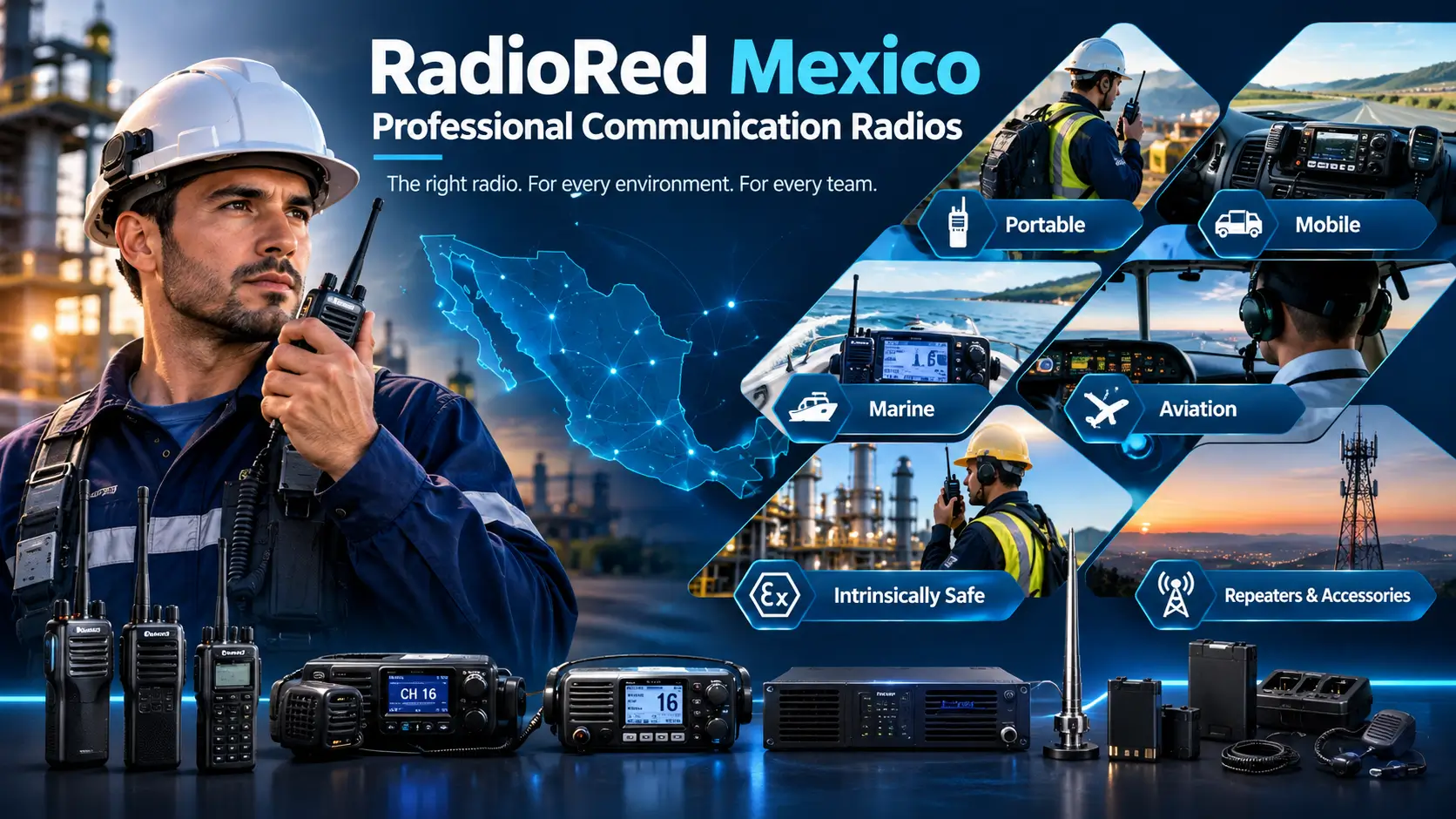
Choosing a professional communication radio is about more than finding the highest wattage or the lowest price. The right equipment depends on where it will be used, how far users need to communicate, the required coverage, battery life, durability, frequency, accessories, safety requirements, and whether the system needs to expand over time.
In Mexico, businesses can choose from portable radios, mobile radios, marine and aviation radios, intrinsically safe equipment, PoC systems, repeaters, antennas, batteries, chargers, and other communication accessories. RadioRed offers a broad range of these solutions and currently carries brands such as ICOM, Kenwood, Motorola, Hytera, and TXPRO.
The best approach is simple: identify the communication problem first, then choose the radio system that solves it.
What Is RadioRed?
RadioRed is a Mexico-based online store specializing in professional radiocommunication equipment. Based in Monterrey, Nuevo León, the company serves customers throughout Mexico. Its catalog includes portable radios, mobile radios, repeaters, antennas, batteries, chargers, accessories and specialized communication equipment.
Its current catalog includes major communication brands such as:
- ICOM
- Kenwood
- Motorola
- Hytera
- TXPRO
- Other specialized communication brands
Because the product range covers different technologies and applications, a search for RadioRed can represent more than simple brand awareness. A potential buyer may also be looking for the right type of radio, comparing brands, checking features, or deciding which communication system fits a particular business.
That is why understanding the different radio categories is important before making a purchase.
What Type of Communication Radio Do You Need?
There is no single radio that is ideal for every organization.
A construction company may need rugged portable radios. A transportation company might need mobile radios installed in vehicles. A marine operation has different requirements from a hotel, while a refinery or chemical facility may require intrinsically safe equipment.
Start with the application.
Portable Radios
Portable radios are designed for users who need to move around while maintaining communication with their team.
They are commonly useful for:
- Construction teams
- Hotels
- Restaurants
- Security personnel
- Warehouses
- Logistics companies
- Maintenance teams
- Manufacturing
- Event production
- Facility management
Portability is the main advantage. Employees can carry the equipment while moving between departments, buildings, vehicles or work areas.
However, portable radios are not all the same.
Before selecting one, compare:
- VHF or UHF frequency
- Transmit power
- Battery capacity
- Number of channels
- Digital or analog capability
- Water and dust resistance
- Audio quality
- Emergency functions
- Compatible accessories
- Programming requirements
RadioRed currently has a dedicated portable-radio category with equipment from brands including ICOM, Kenwood, Hytera, Motorola and TXPRO.
Mobile Radios
Mobile radios are generally installed in vehicles or used as part of a more permanent communication setup.
They can be useful for:
- Transportation companies
- Security fleets
- Delivery operations
- Field services
- Roadside assistance
- Construction vehicles
- Logistics
- Supervisory teams
A mobile radio can be a better solution when employees spend most of their working day inside vehicles.
The important thing is not to assume that a mobile radio is automatically better than a portable one.
They solve different problems.
A field technician who constantly leaves a vehicle may need a portable radio. A fleet operator who spends most of the day driving may benefit more from a professionally installed mobile system.
The antenna, vehicle installation, power supply, and coverage requirements should also be considered.
When Should You Use a Marine Radio?
Marine communication requires equipment designed for the marine environment.
Water exposure, visibility, operating conditions, and marine communication requirements can make a standard land-based radio unsuitable for a vessel.
ICOM, for example, maintains dedicated marine communication products, including VHF marine equipment and other solutions designed for maritime applications.
When comparing marine radios, consider:
- Required marine band and channels
- Water resistance
- Battery life
- Display visibility
- Ease of operation
- GPS features when required
- Compatibility with other marine equipment
- Applicable regulatory requirements
- Installation requirements
The best marine radio is not necessarily the one with the most features. It is the one that matches the vessel, operating environment and communication system.
What Are Aviation Radios?
Aviation radios are designed for communication applications associated with aircraft and aviation environments.
They operate under different requirements from ordinary land-based communication radios. That means a radio intended for construction, security or hospitality should not automatically be considered suitable for aviation.
Before buying aviation communication equipment, verify:
- Frequency compatibility
- Aviation-band requirements
- Regulatory requirements
- Antenna configuration
- Installation requirements
- Power requirements
- Compatibility with the existing communication system
Application-specific requirements should always take priority over general marketing claims.
What Are Intrinsically Safe Radios?
Some industrial environments contain gases, vapors, dust or other substances that can create potentially hazardous conditions.
In these environments, communication equipment may need to meet specific intrinsic-safety requirements.
An intrinsically safe radio is designed and certified for use under defined hazardous conditions by limiting electrical and thermal energy to help prevent ignition of the surrounding atmosphere.
This distinction is important:
A rugged radio is not automatically an intrinsically safe radio.
Water resistance, impact resistance, and dust protection are different concepts from intrinsic safety certification.
RadioRed currently has a dedicated category for intrinsically safe radios and lists equipment with certifications and specifications intended for hazardous working environments.
For industries such as oil and gas, chemical processing, mining, or other hazardous environments, buyers should verify the exact certification, approved battery, approved accessories, and area classification before purchasing.
Digital vs. Analog Radios: Which Is Better?
There is no universal winner.
Analog radios remain useful for many established communication systems and can be appropriate where simple voice communication is the main requirement.
Digital radios can provide additional capabilities depending on the technology and model, including digital voice, improved channel management, identification functions, encryption options on certain systems, and integration with broader communication infrastructure.
RadioRed currently offers radios covering both digital and analog technologies. Its catalog includes products with technologies such as DMR, NXDN, and mixed analog/digital operation.
The better question is not:
“Is digital always better?”
Instead, ask:
“Which technology provides the functions my operation actually needs?”
If you already have an installed radio system, compatibility should be considered before replacing equipment.
What Does a Radio Repeater Do?
One portable radio may work perfectly in a small area but struggle to communicate across a large facility, difficult terrain or a building with significant obstacles.
That is where a repeater can help.
A repeater receives a radio transmission and retransmits it, helping extend the usable coverage of a communication system.
Repeaters can be valuable for organizations that need communication across:
- Large industrial plants
- Warehouses
- Construction sites
- Hotels and resorts
- Campuses
- Rural areas
- Large event locations
- Multiple operational zones
However, repeater performance depends on more than transmit power.
The following can affect coverage:
- Frequency
- Antenna
- Antenna height
- Location
- Terrain
- Buildings
- Interference
- System configuration
- Other infrastructure
RadioRed’s ICOM category includes dedicated repeater products alongside portable, mobile, marine, aviation and accessory categories.
Why Accessories Matter
A professional communication system is more than the radio itself.
Depending on the application, you may also need:
- Antennas
- Spare batteries
- Chargers
- Multi-unit charging systems
- Carrying cases
- Belt clips
- Speaker microphones
- Earpieces
- Programming cables
- Connectors
- Vehicle mounting accessories
- Base-station accessories
RadioRed’s current ICOM section includes antennas, batteries, cases, microphones, software/programming, connectors and other accessories.
This matters because an otherwise suitable radio can become inconvenient to use if employees do not have the right batteries, chargers or audio accessories.
For larger organizations, accessories can also affect the overall cost of ownership.
Why Consider ICOM Radios?
ICOM is one of the major communication brands available through RadioRed.
Its product range covers several professional communication environments, including terrestrial, marine and aviation applications, as well as specialized equipment and accessories.
RadioRed currently organizes its ICOM selection into categories such as:
- Portable radios
- Mobile radios
- Marine radios
- Aviation radios
- Radio accessories
- Repeaters
- Connectors
- Marine solutions
For buyers comparing ICOM equipment in Mexico, RadioRed provides a dedicated ICOM section where different equipment categories can be reviewed according to the intended application.
That is a better starting point than choosing a model simply because it has the highest power rating or the lowest advertised price.
7 Things to Compare Before Buying a Professional Radio
1. Frequency
Check whether the equipment operates within the frequency range required by your communication system.
VHF and UHF are not interchangeable labels that can be selected purely based on which one sounds more powerful. The environment, infrastructure, licensing requirements, and intended application all matter.
2. Transmit Power
Higher power does not automatically guarantee longer real-world communication range.
Coverage is influenced by many factors, including:
- Antenna
- Frequency
- Terrain
- Buildings
- Interference
- Antenna height
- Repeater infrastructure
A properly designed communication system can outperform a higher-powered radio operating with a poor antenna or unsuitable configuration.
3. Battery Life
For teams working long shifts, battery performance can be critical.
Consider:
- Rated battery capacity
- Expected operating time
- Charging time
- Number of batteries required
- Availability of replacement batteries
- Availability of spare charging equipment
A radio that loses power during a critical operation is not a reliable communication solution.
4. Durability
Outdoor and industrial operations may expose radios to water, dust, drops, vibration and other demanding conditions.
Look at the manufacturer’s stated protection rating and testing rather than relying on words such as “rugged” or “professional.”
For example, RadioRed’s current catalog includes portable radios with IP-rated protection and different durability specifications.
5. Technology
Depending on the application, you may encounter:
- Analog
- DMR
- NXDN
- PoC
- IP-based communication
- Mixed analog/digital systems
The newest technology is not automatically the best fit.
Compatibility, coverage, features, recurring costs, and future expansion should all be considered.
6. Accessories and Technical Support
Before buying, check whether the manufacturer or supplier supports the accessories you will need.
Consider:
- Batteries
- Chargers
- Antennas
- Microphones
- Earpieces
- Programming
- Replacement parts
- Mounting equipment
Technical support can become particularly important when a business is deploying a larger radio fleet.
7. Future Expansion
Think beyond today’s requirements.
If your company currently has 10 radio users but expects to have 50 in the future, select an infrastructure that can scale.
A cheaper system may become expensive if the entire communication network needs to be replaced when the organization grows.
RadioRed for Different Industries
The right radio depends heavily on the industry.
Hospitality
Hotels and resorts often need compact communication between housekeeping, maintenance, security, reception and management.
A small portable radio system may be sufficient for one property, while a larger operation may benefit from repeaters or additional infrastructure.
Construction
Construction teams often work in noisy and changing environments.
Useful features may include:
- Loud audio
- Rugged construction
- Long battery life
- Hands-free accessories
- Water and dust protection
- Reliable coverage
Transportation and Logistics
Drivers, warehouse teams and supervisors may need communication between vehicles and operational areas.
Depending on the fleet, mobile radios, portable radios or a combination of systems may be appropriate.
Security
Security teams may prioritize fast communication, emergency functionality, discreet accessories and reliable coverage.
The system should be designed around the physical environment being protected rather than choosing equipment solely by brand.
Industrial Operations
Factories and industrial facilities may require a combination of portable radios, repeaters, antennas and specialized accessories.
Certain facilities may also require intrinsically safe equipment.
What Is PoC Radio?
PoC stands for Push-to-Talk over Cellular.
Instead of relying entirely on conventional local radio coverage, PoC systems can use cellular networks or other IP infrastructure to provide push-to-talk communication over a wider geographic area.
This can be useful when teams operate across cities, regions or multiple sites.
However, PoC and conventional two-way radio systems are not identical.
A buyer should consider:
- Cellular coverage
- Data requirements
- Subscription costs
- Device management
- Geographic operating area
- Integration requirements
- Network availability
RadioRed currently lists PoC-related equipment and categories alongside conventional radio systems.
How Do You Know Which Radio to Buy in Mexico?
Before ordering equipment, answer these questions.
Who will use the radios?
Are they security personnel, technicians, drivers, warehouse workers, construction teams, hotel employees or marine operators?
Where will the radios be used?
Will they operate inside a building, outdoors, across a city, on a construction site, in a vehicle, on a vessel or in an industrial facility?
How much coverage is required?
Consider the actual operating environment rather than relying solely on an advertised range.
Do users need to remain mobile?
If employees move continuously through a worksite, portable radios may make more sense than vehicle-mounted equipment.
Is the environment hazardous?
If gases, vapors, combustible dust or other hazards are present, investigate the required intrinsic-safety certification before selecting the radio.
Does the system need broader coverage?
A repeater, antenna system or IP-based solution may be appropriate when direct radio-to-radio coverage is insufficient.
Will the system grow?
Choose equipment that can support future users, additional channels, new sites and additional infrastructure.
Are RadioRed Deals and Prices Worth Comparing?
Radio equipment prices can change according to model, availability, specifications and promotions.
RadioRed’s current catalog displays products with varying prices and discounts, but these offers can change over time.
That is why the biggest discount is not necessarily the best deal.
For example, an inexpensive radio may not provide the battery life, durability, frequency compatibility or accessories your business needs.
A better buying process is:
Requirement → compatible technology → suitable model → accessories → total cost
This prevents price from becoming the only deciding factor.
RadioRed vs. Choosing a Radio by Brand Alone
Brand recognition can be useful, but it should not replace technical evaluation.
ICOM, Kenwood, Motorola and Hytera all offer different product lines and technologies.
Instead of asking:
“Which brand is best?”
ask:
“Which model and system best fit this application?”
For example, one organization may prioritize a compact portable radio, while another may need an intrinsically safe radio, a repeater network or vehicle-mounted communication.
The correct solution can be different even when two companies operate in the same industry.
Frequently Asked Questions About RadioRed
What does RadioRed sell?
RadioRed sells professional radiocommunication equipment, including portable radios, mobile radios, intrinsically safe radios, marine and aviation equipment, repeaters, antennas, batteries, chargers and other accessories. Its catalog includes brands such as ICOM, Kenwood, Motorola, Hytera and TXPRO.
Does RadioRed sell ICOM radios?
Yes. RadioRed maintains a dedicated ICOM category covering portable, mobile, marine and aviation radios, accessories, repeaters, connectors and marine solutions.
Where is RadioRed located?
RadioRed identifies its operation in Monterrey, Nuevo León, Mexico, and its website states that it serves customers throughout Mexico.
What is the best communication radio?
There is no single best radio for every user. The correct choice depends on coverage, frequency, environment, battery requirements, durability, technology, accessories and the organization’s communication needs.
Does a higher-watt radio always have more range?
No. Range depends on several factors, including frequency, antenna, terrain, obstacles, installation and repeater infrastructure.
Are digital radios better than analog radios?
Not necessarily. Digital radios can offer additional features, but analog systems can still be appropriate for certain applications. Compatibility with the existing communication infrastructure should be considered.
What is an intrinsically safe radio?
It is communication equipment designed and certified for specific hazardous environments where electrical or thermal energy must be controlled to reduce the risk of ignition.
Do I need a repeater?
You may need one when direct radio-to-radio coverage is insufficient across the area where your team needs to communicate. A radio technician should evaluate the environment, antennas, frequencies, and coverage requirements before designing the system.
Final Thoughts: Choose the Communication System, Not Just the Radio
A professional radio is only one part of a larger communication system.
For some businesses, a few portable radios may solve the problem. Others may need mobile radios, repeaters, specialized antennas, marine or aviation equipment, intrinsically safe devices or PoC communication.
That is why the best buying decision starts with the operation.
Think about:
- Where will the radios be used?
- How many people need them?
- How much coverage is required?
- What environmental conditions will they face?
- Which features are genuinely necessary?
- How will the system grow in the future?
Once those questions are answered, comparing brands and models becomes much easier.
For buyers in Mexico researching ICOM equipment, RadioRed provides a dedicated selection covering portable, mobile, marine, aviation, repeater and accessory categories.
The goal should not be to buy the most expensive radio or the radio with the biggest advertised specification.
The goal is to build a reliable communication system that fits the people, environment and work it is designed to support.